

Quick answer: If your baby has eczema, apply a fragrance-free emollient at least twice a day and after every bath, even when the skin improves. Keep baths lukewarm and 5 to 10 minutes long, with an emollient wash instead of soap. Healthy newborn skin needs only plain water for at least the first month. See a GP if you think it's eczema.
The NHS lists heat and changes in temperature among the things that make atopic eczema worse, along with soap, washing detergent and some fabrics. Once the heating goes on, a baby can move between a warm room and cold air outside several times a day. For a baby whose skin is prone to eczema, that kind of change can set off a flare-up.
The NHS says that in babies and toddlers, eczema is also common on the face. NCT notes it is also common behind the knees, on the elbows and on the neck, and it often starts before the first birthday.
Eczema makes skin itchy, dry, cracked, scaly or thickened. The NHS describes how it can look red, or darker or lighter than the surrounding skin, depending on skin tone. It tends to come and go: there are flare-ups, then calmer spells.
A healthy newborn's skin is different. For at least the first month, plain water is enough to clean it, and NCT says moisturisers aren't needed on healthy baby skin. They don't prevent eczema, and they may raise the chance of food allergy and skin infections. If your baby's skin is itchy, rough or flaring, speak to a GP rather than guessing.
Emollients are the main day-to-day treatment for eczema. They leave a film on the skin that holds moisture in, and the NHS says you can't overuse them.
You may need to try a few before finding the one that suits your baby's skin. Some people use a cream during the day and an ointment at night. Don't use aqueous cream, which the NHS no longer recommends because it can irritate skin.
Pharmacies sell emollients without a prescription. Keeping small pots or tubes in the changing bag and anywhere your baby spends time makes it easier to keep up.
| Type | Best for | Keep in mind |
|---|---|---|
| Cream | Daytime | Less greasy, absorbs quickly |
| Ointment | Very dry or thickened skin, night-time | Greasy; not for weeping eczema |
| Lotion | Weeping or hairy areas | Spreads easily but less moisturising |
| Spray | Hard-to-reach or sore skin | Absorbs quickly |
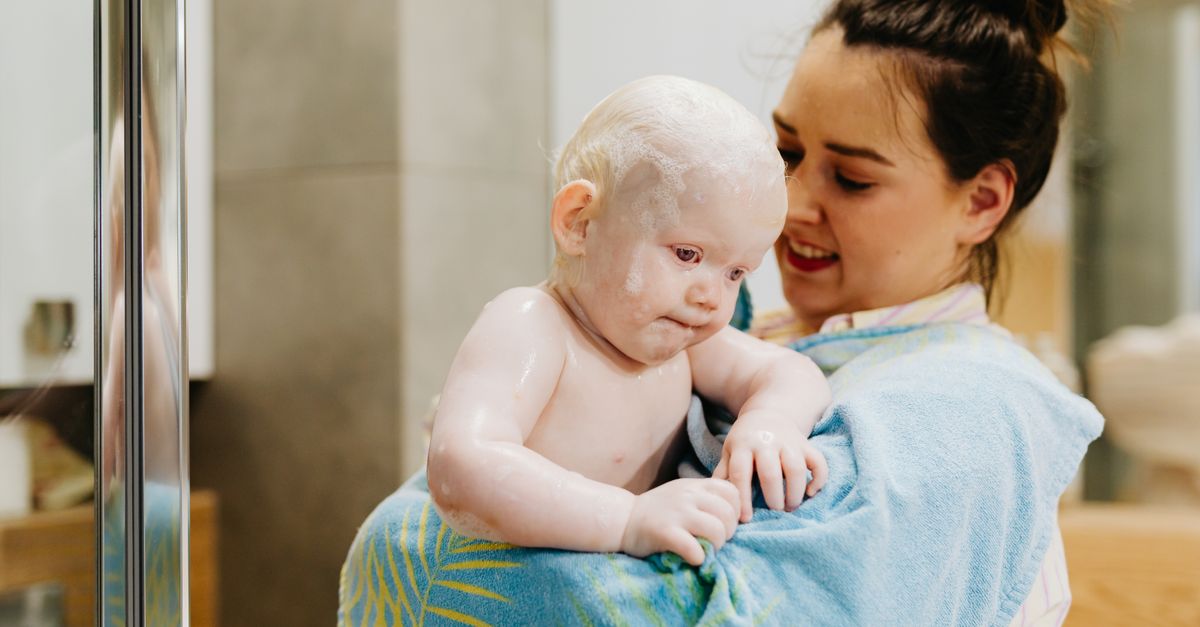
Allergy UK describes a daily bath as part of eczema care because it rinses off irritants and bacteria. How you bathe makes the difference.
Wash and change towels, clothes and sponges regularly to lower the risk of infection. Avoid bath toys that hold water and can't be emptied or dried, such as squirters, because they can harbour mould. Allergy UK doesn't recommend baby powder or talc.
Washing detergent and some fabrics are common irritants. Allergy UK suggests natural fibres and cotton sleepwear. If a particular detergent or garment seems to make things worse, stop using it.
Being hot makes eczema itchier, so the NHS advises keeping cool. In heated rooms, thin layers you can take off are easier to adjust than one thick outfit. Keep your baby's nails short, and anti-scratch mittens can protect the skin from scratching.
Emollients aren't flammable on the skin. However, the NHS warns that clothing and bedding with emollient on them catch fire more easily. Washing at high temperatures reduces the build-up but doesn't remove it completely. In winter, that means keeping your baby's clothes and bedding away from open fires, candles and other naked flames.
A pharmacist can advise on small patches that are dry and only slightly itchy. See a GP if you think your baby has eczema, or if treatments aren't helping. For severe eczema, the NHS says to talk to a GP, nurse or health visitor, as a stronger treatment such as a steroid cream may be needed. Some children are referred to a skin specialist.
If an emollient makes your baby's skin sting or burn and this doesn't settle after a few days, ask a GP, nurse or pharmacist about switching products.
Ask for an urgent GP appointment or call 111 (for children under 5) if your baby has eczema and any of the following apply. The NHS says these can be signs of infection or of eczema herpeticum, a more serious condition that may need treatment such as antibiotics.
Not unless a doctor tells you to. The NHS advises against changing your diet, or your baby's, without medical advice.
No. Atopic eczema isn't contagious. It's more likely if a parent has eczema or a close family member has asthma or hay fever.
NCT suggests choosing alcohol-free and fragrance-free wipes where possible, or using cotton wool with plain water. Stop using anything that seems to irritate your baby's skin.
There's no cure, but the NHS says symptoms usually improve as children get older, and treatment can keep flare-ups under control in the meantime.
General information, not individual medical advice. Speak to your GP, midwife or health visitor about your baby’s needs.
Flu and RSV vaccines in pregnancy: when to have each one this autumn
Read moreabout Flu and RSV vaccines in pregnancy: when to have each one this autumn
Croup in babies: what the barking cough means and when to call 111
Read moreabout Croup in babies: what the barking cough means and when to call 111
Fireworks and babies: protecting sleep and hearing around Bonfire Night
Read moreabout Fireworks and babies: protecting sleep and hearing around Bonfire Night
Share:
Flu and RSV vaccines in pregnancy: when to have each one this autumn
Halloween with a baby or toddler: costumes, face paint and sweets