

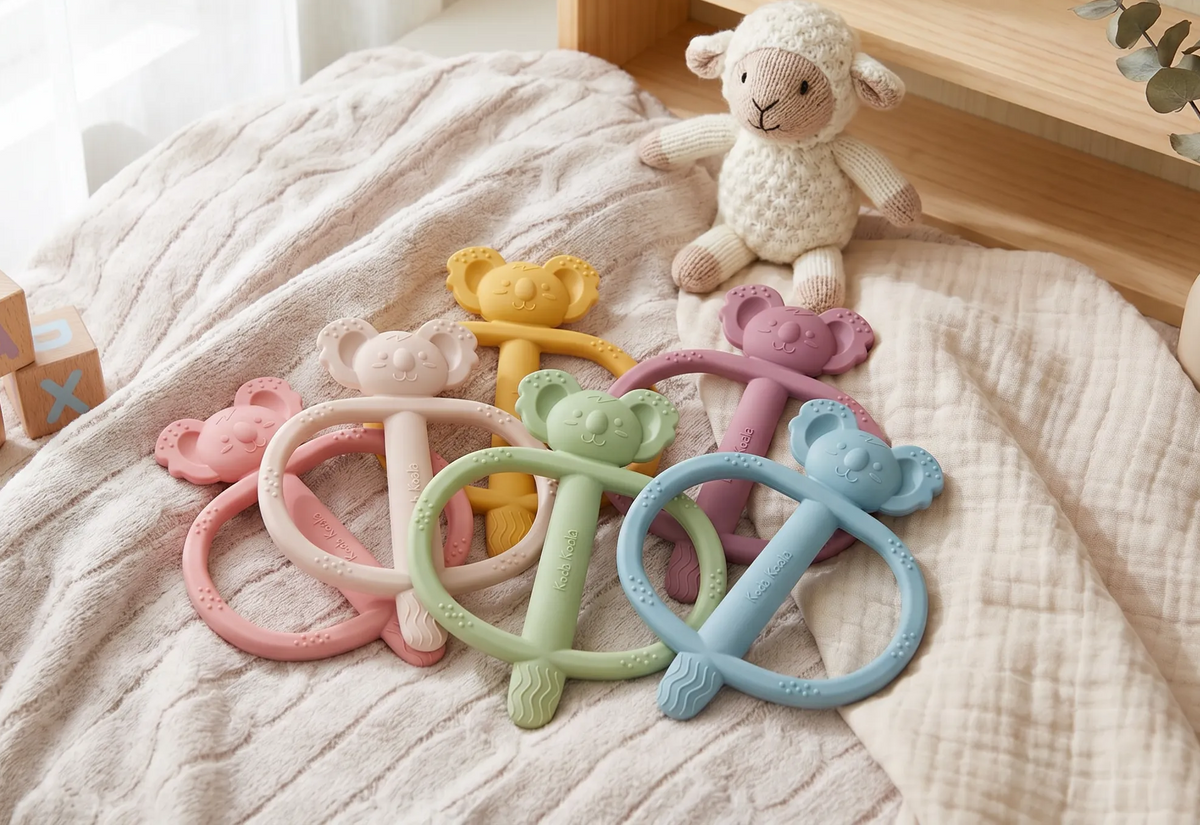
Quick answer: Silicone is a soft, flexible material that suits teething, but the material alone doesn't make a finished teether safe. Choose a teether sold with clear age guidance, warnings and manufacturer details, check it for damage before every use, keep your baby in sight while they use it, never tie it around their neck, and follow its own cleaning instructions.
What parents need to know
Teething rings give your baby something safe to chew on, which can ease discomfort and distract them from the pain. What matters most is the individual product and how you use and clean it.
Are silicone teethers safe for babies?
Silicone teethers can be a safe way to soothe sore gums, but safety comes from the finished product rather than the material name. Teething rings give your baby something to chew safely, which may ease discomfort and distract them from any pain.
In Great Britain, teethers intended for play are covered by the Toys (Safety) Regulations 2011. Manufacturers must design and assess the toy against essential safety requirements, and any hazard information must be marked clearly in English and preceded by the word "Warning".
So the honest answer is that a silicone teether is as safe as the specific item you've bought, the instructions it came with, and how closely you follow them.
What should I look for when choosing one?
Look for a teether that arrives with proper paperwork rather than one that simply looks appealing. Toys must carry a conformity marking (UKCA or CE) affixed visibly and indelibly to the toy, its label or its packaging, and must be accompanied by instructions for safe use, safety information and warnings.
The manufacturer's name, trade name or trademark and a contact address must also appear on the toy, its packaging or an accompanying document, along with details identifying the item. If a product can't be traced back to a responsible business, that is a reason to pass on it.
Age guidance matters too. The regulations pay particular attention to toys intended for children under 36 months, so check that the age marking matches your baby's stage.
What should I check before every use?
A quick check each time takes seconds and catches most problems early.
- Read the instructions — Follow the age guidance and instructions supplied with your teether, including any chilling times.
- Inspect every surface — Check surfaces, seams and joins, and stop using the item if it is torn, cracked or damaged.
- Remove packaging — Take off all packaging and keep loose parts and small objects out of your baby's reach, as small items can lodge in a child's airway.
- Stay nearby — Always watch your baby while they are eating in case they choke. Staying with your baby while they use a teether is sensible practice too, so you can see if anything comes loose.
- Never tie it on — Never tie a teething ring around your baby's neck, as it may be a choking hazard.
Do different teether materials need different care?
Often, yes. Many teethers combine silicone with other materials, and the instructions supplied with your item are the only reliable guide to cleaning that particular design.
Clean the teether as its own instructions direct, including any instruction from the manufacturer to clean it before first use. A dishwasher may be used for cleaning where the instructions for that exact item allow it, but bear in mind that putting equipment through a dishwasher cleans it without sterilising it. Sterilising is separate: steam sterilising, boiling or a cold-water sterilising solution should only be used where the instructions for that exact item allow them, and before boiling anything, make sure the item is safe to boil.
If the instructions for your teether do not permit a dishwasher, steriliser or boiling water, don't use those methods on it. Where you're unsure, check with the manufacturer rather than guessing.
How should I clean a silicone teether?
Wash it in hot, soapy water as soon as possible after use, rinse thoroughly in clean, cold running water, and let it dry completely. If the instructions permit sterilising, follow the manufacturer's directions for the method you're using.
Cold-water sterilising solution needs at least 30 minutes with no trapped air bubbles, and the solution should be changed every 24 hours. Steam sterilisers vary, so follow the instructions for your model. If boiling is allowed, keep the item fully submerged for at least 10 minutes and set a timer.
Whichever method you use, keep checking that the item hasn't torn, cracked or become damaged — repeated boiling in particular shortens the life of soft parts. After sterilising, it's best to leave the item in the steriliser or pan until you need it; wash and dry your hands before handling it, or better still use sterile tongs, and put it down on a clean, disinfected surface.
Can I chill a teether in the fridge?
Some teething rings can be cooled in the fridge first, which may help soothe your baby's gums. Only chill a teether if its own instructions permit it, and stick to the chilling time stated.
Never put a teething ring in the freezer — if it becomes frozen it could damage your baby's gums.
Helpful tip
Other ways to comfort a teething baby
Comforting or playing with your baby can distract them from gum pain, and gently rubbing their gums with a clean finger may help. If they're dribbling more than usual, gently wiping their face can help prevent a rash.
If your baby is 6 months or older and has started weaning, healthy things to chew on such as raw fruit and vegetables can help — soft fruit like melon is soothing. Always watch them eating in case they choke, and avoid rusks and other sugary foods, which can cause tooth decay.
If your baby is in pain, a sugar-free painkiller may help: paracetamol from 2 months, ibuprofen from 3 months. Always follow the instructions with the medicine, and speak to your GP or pharmacist if you're unsure.
From Infatot
Which Infatot teether is right for your baby?
Materials and care requirements vary across the range, so always check the materials, contents, age guidance and care instructions listed for the exact item you're choosing.
The instructions supplied with your teether tell you how to clean it and which cleaning or sterilising methods, if any, are suitable for that design. Follow those in preference to general advice.
You'll find product-specific details in the teether collection. If you need replacement instructions or help identifying your item, contact us before choosing a cleaning or sterilising method.
Explore this Infatot productFrequently asked questions
Can I put a silicone teether in the dishwasher?
Only where the instructions for that exact item allow it. Bear in mind that a dishwasher cleans the item without sterilising it, so it is not a substitute for sterilising.
Can I put a baby teether in the freezer?
No. A frozen teether could damage your baby's gums. Some teething rings can be cooled in the fridge instead, but only if their own instructions permit it and only for the chilling time stated.
How do I clean a silicone teether?
Wash it in hot, soapy water as soon as possible after use, rinse thoroughly in clean, cold running water and let it dry completely. If the instructions permit sterilising, follow the manufacturer's directions for your method.
Sources & further reading
- NHS — Tips for helping your teething baby
- NHS — How to stop a child from choking
- NHS — Sterilising baby bottles
- GOV.UK — Toys (Safety) Regulations 2011: Great Britain — GOV.UK
- NHS — Looking after your baby's teeth
General information, not individual medical advice. Speak to your GP, midwife or health visitor about your baby’s needs.



Share:
Best Baby Teethers UK (2026): A Parent's Buying Guide
Bronchiolitis and RSV in Babies: What UK Parents Should Know This Autumn