

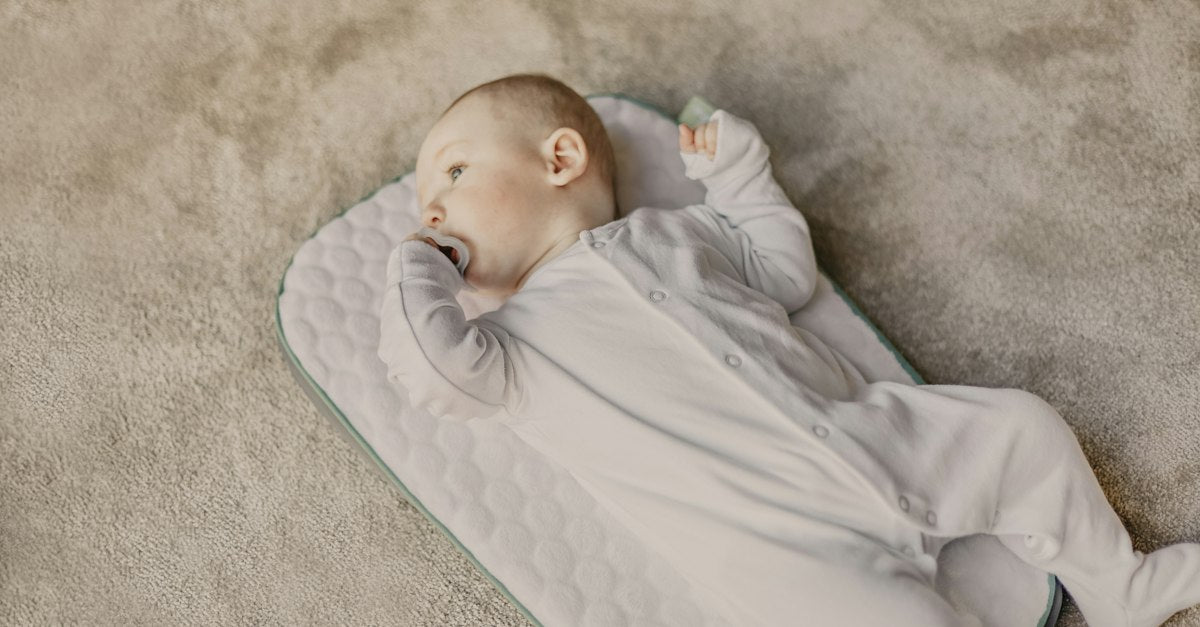
Quick answer: Keep your baby's room between 16 and 20°C, which the NHS says is comfortable and safe for sleeping babies. At that temperature a sleepsuit and a 2.5 tog sleeping bag usually works. To check how warm your baby is, feel their chest or the back of their neck, not their hands.
Once the heating comes on, a nursery can climb past 20°C without you noticing, especially if the cot is near a radiator. A room thermometer by the cot gives you a reading instead of a guess, and the NHS recommends using one.
When the house turns cold, it's natural to want to add layers. The NHS is clear that babies are better off cooler than too hot, because overheating raises the risk of sudden infant death syndrome (SIDS). This applies to every sleep, day or night, up to 12 months.
Sleeping bags have a tog rating, which tells you how warm they are. The NHS lists these ranges for commercial sleeping bags. Use them as a starting point and check the manufacturer's label too.
A sleeping bag needs to fit well around the shoulders so your baby's head can't slip down inside. Don't put any other bedding on top of it.
| Room temperature | Sleeping bag tog | Typical use |
|---|---|---|
| 16 to 20°C | 2.5 tog | All year, standard rooms |
| 20 to 24°C | 1.0 tog | Warmer weather and warmer rooms |
| 24 to 27°C | 0.5 tog | Hot weather |
In winter, the NHS says a sleepsuit plus a sleeping bag, or a sheet and/or blanket, should be fine. Change the clothing under the bag to suit the tog and the room temperature.
If your baby is in a sleeping bag and seems cold, the NHS advises adding one more layer of clothing, not extra blankets. A thermometer reading below 16°C means the room needs warming.
Use a lower-tog bag and fewer layers. On the warmest nights, a vest or just a nappy is enough.
Choose lightweight cellular cotton blankets, which keep your baby warm and still let air through. Avoid thick, fleecy or padded ones.
Lay your baby on their back in the feet-to-foot position, with their feet at the foot of the cot. Tuck the blanket in firmly no higher than the shoulders. Don't double it over: a folded blanket counts as two.
Soft items around a baby, especially near the head, can cause overheating and raise the risk of SIDS. The NHS advises keeping the cot clear of anything that could cover your baby's face or head.
Take off hats and extra clothing as soon as you come indoors, even if it wakes your baby.
Small babies aren't good at controlling their own temperature. They can overheat from too much clothing, too much bedding or a room that's too warm.
Get an urgent GP appointment or contact 111 if you're worried about your baby or think they might be ill.
Call 999 if your baby stops breathing, won't wake up, is struggling to breathe, is stiff, shaking or jerking, or is limp, floppy or not responding like they normally do. Also call if their lips, tongue, face or skin suddenly turn pale, blue or grey. On black or brown skin, this may be easier to see on the palms of the hands or the soles of the feet.
Usually not. The NHS says that, even in winter, most babies who are unwell or feverish don't need extra clothes. Contact 111 or your GP if you're worried. NHS guidance
Take off hats and extra layers as soon as you get into a warm car, bus or train. It's fine for your baby to fall asleep in the car seat while you're travelling, but take them out once you arrive. NHS guidance
Yes. A mattress that isn't firm enough makes it harder for a baby to lose heat. Your baby's head shouldn't sink in by more than a few millimetres. NHS guidance
Follow the same safer sleep advice, but for a year from your baby's due date rather than their birth date. NHS guidance
General information, not individual medical advice. Speak to your GP, midwife or health visitor about your baby’s needs.
The clocks go back on 25 October: how to shift your baby's sleep
Read moreabout The clocks go back on 25 October: how to shift your baby's sleep
How to Swaddle a Baby: A Step-by-Step Guide for UK Parents
Read moreabout How to Swaddle a Baby: A Step-by-Step Guide for UK Parents
How to Soothe a Teething Baby at Night

Share:
Vitamin D drops for babies: who needs them from October
Fireworks and babies: protecting sleep and hearing around Bonfire Night