

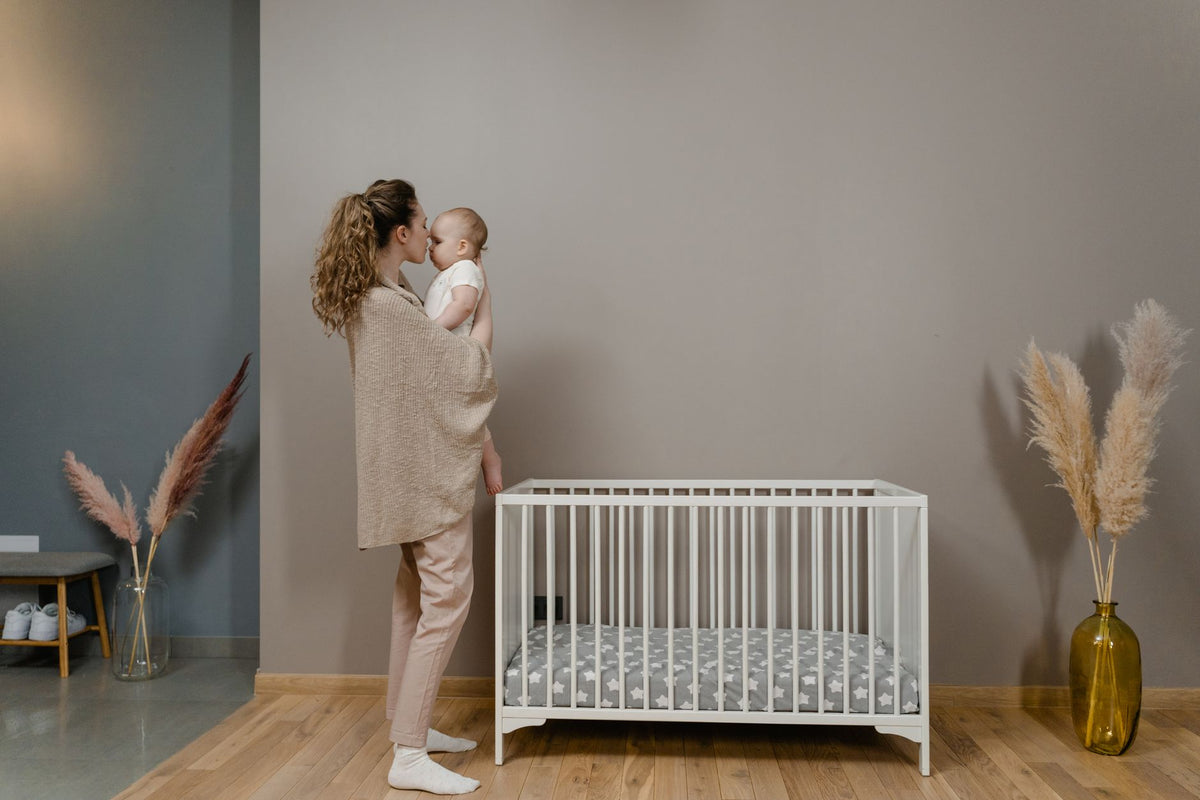
Quick answer: For babies, sleeping through the night usually means a 5–6 hour stretch, and most don't do it consistently until at least 6 months. Help it along with a predictable bedtime routine from around 6–8 weeks, putting your baby into the cot drowsy but awake, and safe sleep: on their back in a separate cot or Moses basket in your room for at least 6 months, at 16–20°C, on a firm, flat mattress with no loose bedding under 12 months.
One of the most common questions new parents ask is: when will my baby sleep through the night? The honest answer is that it varies enormously, but there are proven strategies that can help nudge things in the right direction.
This guide covers what to realistically expect at each stage, how to build healthy sleep habits, and what "sleeping through" actually means for babies.
First, a reality check: sleeping through the night for a baby typically means a stretch of 5–6 hours without waking, not 8–12 hours like an adult. Most babies don't consistently sleep through until at least 6 months, and many not until well into their first year — or beyond. This is completely normal.
Babies have shorter sleep cycles than adults (around 45–50 minutes compared to 90 minutes) and they spend more time in light sleep. This means they wake more frequently and often need help settling back to sleep. As they mature, they gradually learn to link sleep cycles independently, which is what we call "sleeping through."
A consistent, calming bedtime routine is one of the most effective tools you have. It doesn't need to be complicated, just predictable. A good routine might look like:
The same sequence every night helps your baby's brain associate these cues with sleep. Most babies respond well to a routine from around 6–8 weeks.
A sleep association is anything your baby uses to fall asleep. Some are fine, such as a dummy or white noise. If you use a comforter or soft toy, keep it out of the cot while your baby is under 12 months, as the NHS advises keeping the cot clear of soft toys. Others can become problematic if your baby can't replicate them when they wake in the night, like needing to be rocked or fed to sleep every time.
The goal over time is to help your baby fall asleep with associations they can access themselves, so when they surface between sleep cycles, they can resettle without your help.
The NHS and Lullaby Trust both recommend:
A well-fitted baby sleeping bag is the safer choice, rather than swaddling or loose blankets. It stops your baby wriggling under their bedding and keeps them at a steady temperature. Make sure it fits well around the shoulders so your baby's head cannot slip down into the bag, and choose the right tog rating for the room temperature.
Newborns need feeding every 2–3 hours and this is normal. Their stomachs are tiny and their sleep is biologically designed to be light. Focus on feeding well, following safe sleep guidance, and survival mode for now.
Many babies start consolidating their longest sleep stretch in the early months. Some will sleep 4–6 hours by 3 months. You can start introducing a simple bedtime routine.
This is the most common window for sleep training if you choose to do it. For some babies at this age, night feeds may no longer be necessary, but not all babies are the same. Common approaches include gradual retreat, pick-up-put-down, and Ferber-style methods.
Call 999 if your baby:
Do not drive yourself to A&E. The person you speak to at 999 will give you advice about what to do.
Get an urgent GP appointment or contact NHS 111 if you are worried about your baby or think they might be ill.
If sleep deprivation is significantly affecting your health or your baby's wellbeing, your health visitor can refer you to local sleep support services. You don't have to manage alone.
Most babies don't consistently sleep through until at least 6 months, and many not until well into their first year or beyond. This is completely normal.
Most babies respond well to a consistent bedtime routine from around 6–8 weeks. Keep it simple and predictable — the same calming sequence every night helps your baby associate those cues with sleep.
The NHS and Lullaby Trust both recommend a room temperature between 16–20°C, a dark room, and a firm, flat mattress with no pillows or loose bedding for babies under 12 months.
Six to twelve months is the most common window if you choose to do it. For some babies at this age, night feeds may no longer be necessary.
General information, not individual medical advice. Speak to your GP, midwife or health visitor about your baby’s needs.
Fireworks and babies: protecting sleep and hearing around Bonfire Night
Read moreabout Fireworks and babies: protecting sleep and hearing around Bonfire Night
What should a baby wear to bed when the house gets colder?
Read moreabout What should a baby wear to bed when the house gets colder?
What temperature should your baby's room be once the heating goes on?
Read moreabout What temperature should your baby's room be once the heating goes on?


Share:
Baby Colic: Symptoms, Causes and How to Help Your Baby
How to Choose the Right Baby Carrier for You and Your Baby